

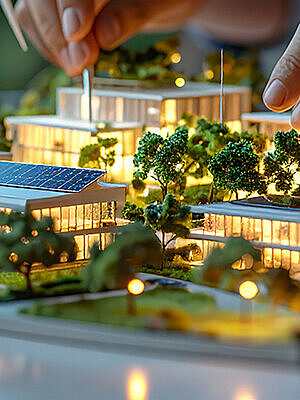
Cities face challenges related to climate change, pollution, and rapid urbanization, which require a rethinking of their design and management through more sustainable materials, smart infrastructure, and data-driven planning tools. LIST is accelerating this transformation by developing innovative solutions: new construction materials, advanced sensors, cutting-edge digital technologies, and robust digital infrastructure, enabling more efficient construction, a reduced environmental impact and more sustainable and resilient cities in the face of climate risks.
In 2025, LIST continued its commitment to developing scientific and technological solutions for a sustainable, connected, and resilient future. Through several flagship projects, the research teams demonstrated their ability to advance knowledge while addressing the concrete challenges facing Luxembourgish and European society.
The climate transition and the need to rethink urban spaces guided the “Shaping sustainable neighborhoods in Luxembourg” (SERENE) project. It illustrates LIST’s commitment to supporting decision-makers and urban planners through data-driven methodologies, enabling the design of more sustainable, inclusive, and resilient neighbourhoods. By combining modeling, territorial analysis, and forward-looking scenarios, SERENE helps shape the living spaces of tomorrow while addressing the energy, environmental, and social challenges specific to Luxembourg.
In addition to territorial challenges, LIST has helped advance the next generation of networks through the European project “Integrating Network Digital Twinning into Future AI-based 6G Systems” (6GTWIN). It has reached a key milestone by defining an architecture that is fully AI-native and a common vision of the digital twin applied to networks. The first public results are already paving the way for concrete applications, notably remote-controlled driving and predictive energy management, where digital twins ensure reliable connectivity while reducing energy consumption. By laying the groundwork for autonomous 6G networks capable of self-optimization without human intervention, 6G TWIN is setting the stage for major advancements in autonomous mobility, industry, smart cities, and European sustainability goals. The project’s second phase will focus on large-scale validation, with fully operational prototypes expected in 2026.
Finally, LIST has officially launched the PASTA 5G project, developed with IEE Sensing and co-funded by the FNR’s 5G BRIDGES programme. This project paves the way for a new generation of transparent antennas for 5G networks, capable of being discreetly integrated into the windows of buildings or vehicles. These innovative antennas improve coverage in dense urban environments, optimize vehicle-to-everything (V2X) communications, and utilize advanced beam steering technologies to direct signals in real time. Thanks to the transparent materials and electronic solutions developed at LIST, PASTA 5G aims to provide high-performance, reliable, and aesthetically pleasing connectivity, designed for the smart cities and mobility of tomorrow.
